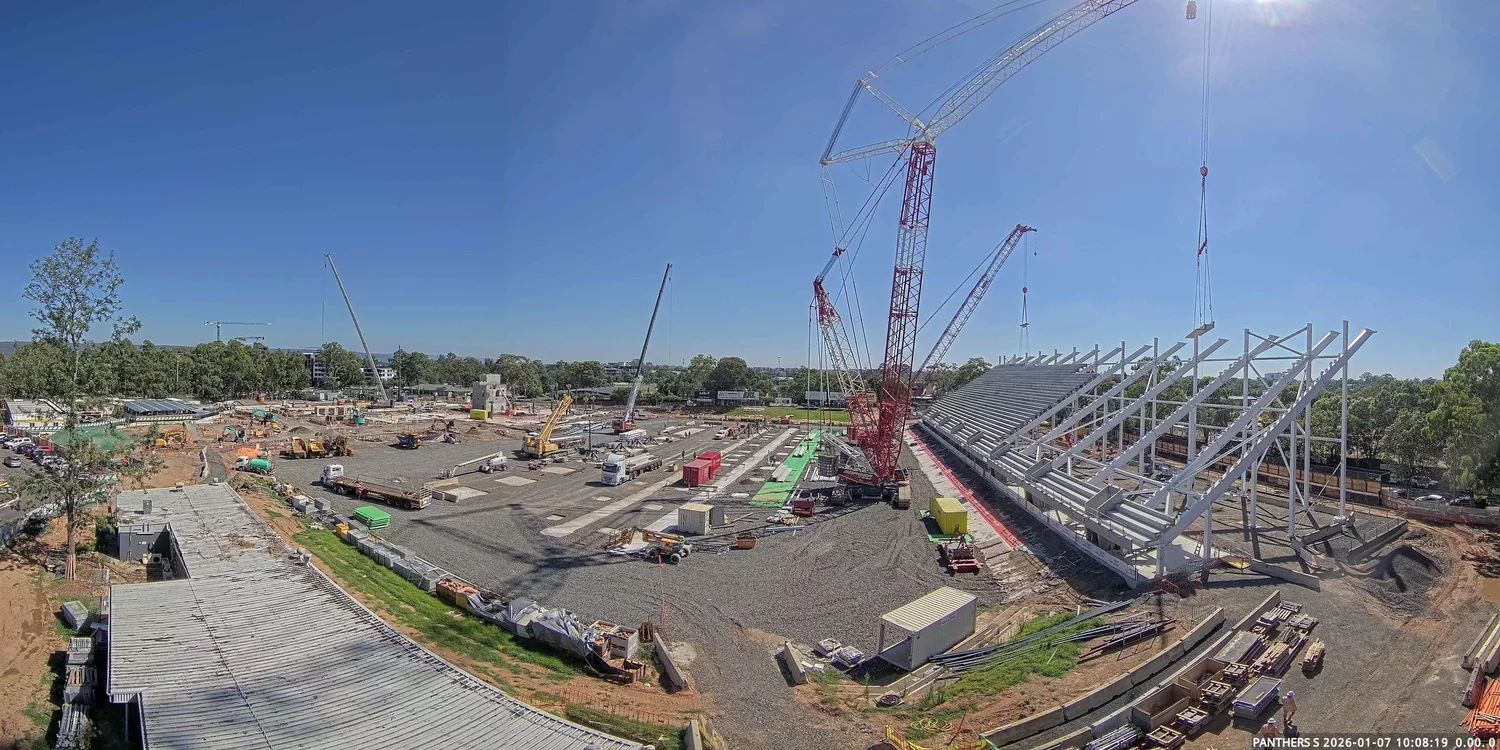
John Holland &
Penrith Stadium
Project Intelligence: Reducing crane downtime and achieving a 40% increase in lift rates using the Vita Load Navigator (VLN).
The Challenge:
The "Danger Zone"
Traditional lifting required ground crews to be in close proximity to loads for manual orientation, exposing the project to critical risks:
- Tagline Entanglement: snagging on complex stadium tier reinforcement.
- Weather Volatility: loads becoming uncontrollable in Sydney wind gusts.
- Human Error: Inconsistent orientation leading to time-consuming positioning.
The Solution:
Semi-Autonomous Control
John Holland integrated the VLN to move beyond passive lifting, replacing high-risk manual intervention with aerospace-grade thruster technology.
Active wind-rejection and telemetry allowed the crane to operate continuously, safely navigating the unpredictable corridors of the stadium build.
"With the introduction of the VLN, the plats were literally flying in."
Autonomous Repeatability
A critical factor in the Penrith Stadium success was the VLN’s Heading Memory.
Millimetre Precision
Loads are oriented to within ±1° accuracy on the very first drop, eliminating manual handling at the bolt face.
Heading Memory
Operators pre-set coordinates. The VLN automatically rotates and locks the load, eliminating manual fine-tuning.
Repeatable Cycles
Automating orientation creates a predictable rhythm. The crane maintains a high-speed shuttle regardless of wind.
Quantified Performance Data
| Metric | Traditional | VLN Tech | Gain |
|---|---|---|---|
| Daily Lift Count | 8 Lifts | 11–13 Lifts | +40% Production |
| Orientation Control | Manual | Autonomous | High Consistency |
| Remote Range | Hands-on | 183 Metres | Danger Zone Removed |
| Wind Ceiling | 12 m/s | 20 m/s | 66% Window Increase |
Safety & Compliance
The VLN effectively "de-risked" the Penrith site:
- Zero-Contact Management: Removal of riggers from the line of fire.
- AS/NZS Mapping: Strict compliance with Australian statutory requirements.
- Wind Resilience: Maintaining stability in grounding conditions.
Conclusion
The Penrith Stadium redevelopment serves as a benchmark for Australian infrastructure. Smarter control systems are the key to meeting aggressive milestones safely and ahead of schedule.
Achieve Similar Results
Contact our engineering team to assess your project's lifting requirements and wind matrices.
Request Project ConsultationChapter:
London Bridge.
Built on one of the tightest footprints in central London—wedged between Network Rail and St. Thomas Hospital. VLN technology was utilised to navigate extreme wind tunnel effects and achieve millimetre-precision in a high-density urban corridor.
Project Site
London Bridge, UK
Season Risk
12 Named Storms
Operational Resilience
Spatial Constraints
Cranes positioned on steel cantilevers over pit-lanes required Zero Float execution to maintain the critical path.
Key Challenges
- • Just-in-time delivery schedule
- • Severe wind tunnel effects
- • High-density urban interface